Area Legends
The Legend of Swift's Lost Silver Mine
A journal no one can authenticate, a Frenchman named Munday, a blind man searching the ridges, and two and a half centuries of treasure hunting in the mountains around the Breaks.
- THE JOURNAL
- Covers the 1760s
- FOUND?
- Never located
- CLAIMED IN
- Four states
- BREAKS FROM THE LODGE
- 20 to 25 min, 10 mi
Quick Answer
Swift's lost silver mine is the oldest treasure legend of the central Appalachians. According to a journal attributed to John Swift, sometimes called Jonathan Swift, he and a small company made trips from Alexandria, Virginia during the 1760s to a secret silver mine west of the mountains, smelted the ore, and hid silver bars and coins in rock shelters before concealing the mine. Swift is said to have returned years later, blind, and never found it again. Many conflicting copies of the journal exist and no original has ever been produced. No mine has been found, and historians and geologists are skeptical. The Dickenson County version of the legend places the silver in the wild country of the Breaks and the McClure River, and the hunt has never stopped.
The Journal
Every version of the legend starts with a journal. In it, Swift describes leaving Alexandria, Virginia with a few men and pack horses, crossing the mountains, and working a silver deposit somewhere beyond them, coming and going over most of a decade. The party carried in supplies and carried out silver bars and coins.
The trouble is that there is no single journal. There are many copies, and they do not agree. One widely reprinted version begins on June 25, 1761. Another, examined in the Filson Club History Quarterly in 1980, places the first trip on June 21, 1760. Routes, companions, and hiding places shift from copy to copy. Henry P. Scalf, the eastern Kentucky historian, wrote that historians generally agree there was a real man named Swift, but that no one can say the journal is genuine.
That uncertainty has never slowed anyone down. If anything, it is the engine of the legend. Every copy is a slightly different map.
George Munday and the Shawnee Silver
The legend gives Swift a guide. In most versions he meets a Frenchman named George Munday, sometimes spelled Mundy, who had been held captive by the Shawnee. Munday tells Swift that his captors had taken him to rich silver deep in the wilderness beyond the mountains. Some versions tie Swift and Munday to the French and Indian War years and General Edward Braddock's 1755 campaign, the same campaign where a young Daniel Boone first heard about Kentucky.
Swift, the story goes, saw a fortune. He outfitted an expedition, Munday showed the way, and the mining began.
The Last Trip and the Blind Man's Curse
In the journal's telling, the final season ended in the fall of 1769. The company concealed the workings completely and headed home. Along the way, raiders took horses loaded with silver, and the party buried what they could carry no farther. They reached Alexandria near the end of the year. Munday, the story says, later went back for a share of the treasure and was killed.
Swift meant to return. Some versions say he was jailed in England for speaking up for the American colonies. When he finally came back to the mountains, he had gone blind. Leaning on his notes and his fading memory, he searched the ridges and never found his silver again. He died with the secret still in the hills, and the journal began to pass from hand to hand.
The Dickenson County Version
Every county that claims Swift tells the story its own way. In the Dickenson County version, three men named Swift, Jefferson, and Munday found the silver deep in the Cumberlands. After hiding the mine, they set out for the nearest settlement, Castlewood on the Clinch River, and fell into a bitter quarrel on the way over how to divide the riches.
Old-timers passed down Swift's clues like scripture. The land near the mine was said to be thin and nearly level, with big timber on the north side and scrubby little trees on the south. In the middle of the prospecting ground stood a forked oak, where the men wedged a pine knot with one end pointing toward the mine and the other toward the spot where silver was hidden. Some versions say initials for Munday, Jefferson, and Swift were carved nearby, and that the ore looked like rock shaped like corncobs.
Dickenson County pioneers Joseph Kelly and John Ervin prospected the McClure River country for the mine without success. Persistent rumors have long placed it in the wild, nearly inaccessible reaches of the Breaks along the Virginia and Kentucky border, and every generation has had its searchers.
Four States, One Treasure
Swift's silver does not belong to Dickenson County alone. Claims stretch across four states, from Southwest Virginia and eastern Kentucky to southern West Virginia and upper East Tennessee. Eastern Kentucky has Swift Creek in the Red River Gorge and a long tradition of searchers in Wolfe County. Kentucky historian Ed Henson has called it the oldest recorded legend in Kentucky.
The legend even touches a founder. James Harrod, who founded Harrodsburg, disappeared in 1792 and was never found, and some have believed he died searching for Swift's silver.
There is also a paper trail that keeps the believers going. A 1788 Virginia treasury warrant recorded by John Filson, Kentucky's early mapmaker and historian, covered 1,000 acres said to contain Swift's mine. For a legend, that is a remarkably official-looking footnote.
What Historians and Geologists Say
The skeptics have strong ground to stand on. No original journal has been found, only copies that contradict one another. No silver bars, coins, smelting works, or mine have ever been documented. The Pike County Historical Society has noted that concrete proof of Swift's treasure has never been offered, and that there has never been a satisfactory explanation of how Swift would have known about silver ore in these mountains in the first place.
Geologists have long pointed out that the coal-bearing sandstone and shale of the Cumberland Plateau are not the kind of rock where workable silver veins form. In 1980, writer Joe Nickell examined the legend at length in the Filson Club History Quarterly and laid out the case for other explanations, including that the "silver" story may have grown from something other than a mine.
So the honest summary is this: there may have been a real Swift, there certainly were many journals, and there has never been any silver.
Why the Legend Lasts
Because nobody can prove it is false. Because the clues are just specific enough. A forked oak. A pine knot. Big timber to the north, scrub to the south. Every hollow in the Breaks has a forked oak somewhere, and every hiker who sees one thinks, for half a second, about Swift.
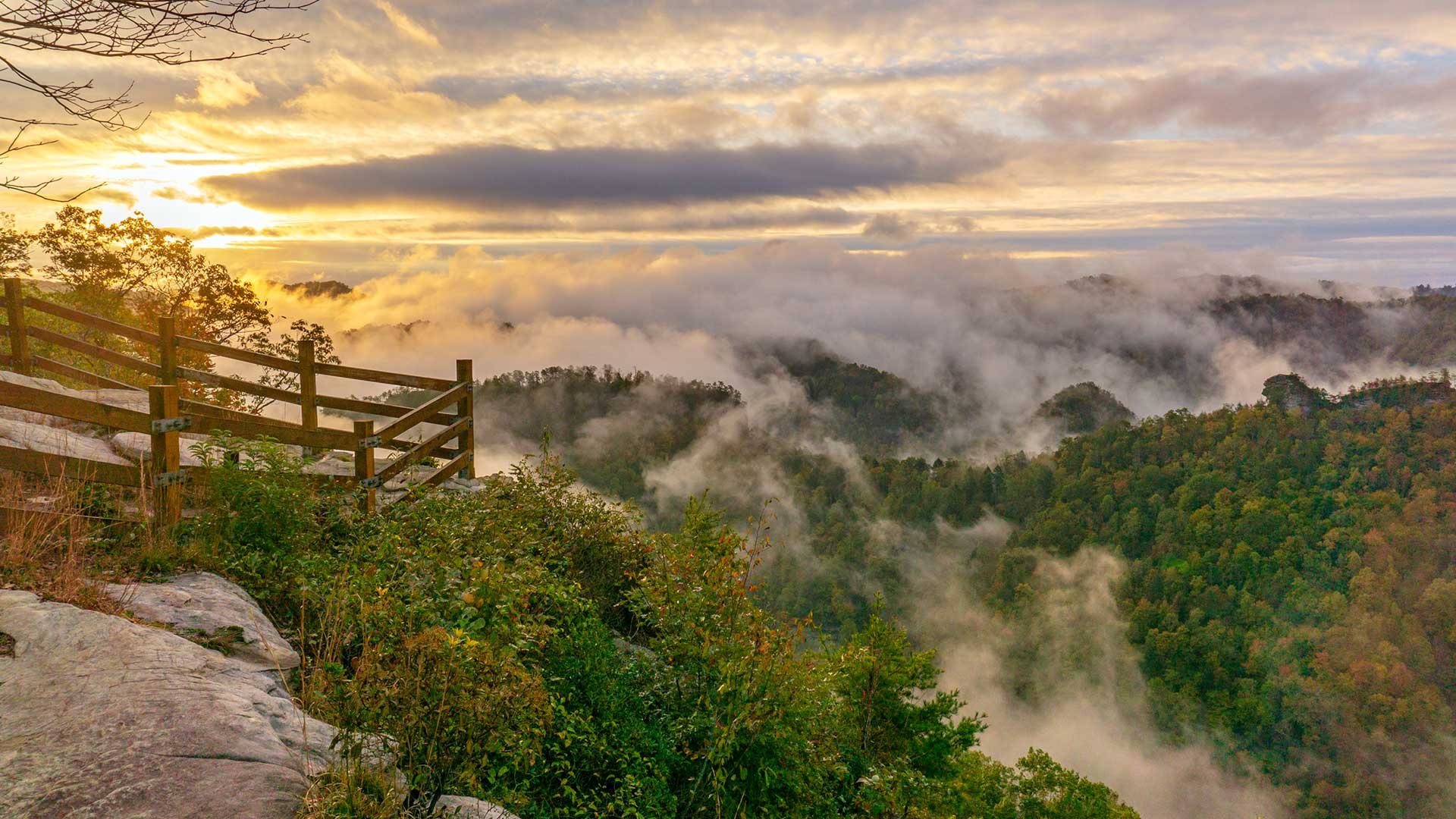
And because the country itself makes it believable. Stand at an overlook above the Russell Fork, look down into a gorge that stopped Daniel Boone, and it is not hard to imagine that something could stay hidden down there for two hundred and fifty years.
Key Facts
| Legend | A lost silver mine and hidden silver worked by John Swift and companions |
|---|---|
| Swift's name | John Swift, sometimes Jonathan Swift |
| Period described | The 1760s, ending in the fall of 1769 |
| Starting point | Alexandria, Virginia |
| Guide | George Munday (or Mundy), a Frenchman once held captive by the Shawnee |
| Key clues | A forked oak, a pine knot pointer, thin level land, big timber on the north side |
| Dickenson County version | Swift, Jefferson, and Munday, quarreling on the way to Castlewood |
| Local searchers | Joseph Kelly and John Ervin, McClure River country |
| States claiming it | Virginia, Kentucky, West Virginia, Tennessee |
| Paper trail | 1788 Virginia treasury warrant recorded by John Filson for 1,000 acres |
| Journal status | Many conflicting copies; no authenticated original |
| Mine found | No |
| Breaks Interstate Park from Flannagan Lodge | 10 miles, 20 to 25 minutes |
A Basecamp for Legend Hunters
Flannagan Lodge sits on Big Ridge Road, State Route 63, just outside Haysi, 10 miles, 20 to 25 minutes from Breaks Interstate Park and close to the McClure River country where Dickenson County's searchers looked for Swift's silver.
It was taken down to the studs and fully remodeled in 2022 and 2023, and it was built for privacy: a private entrance, a private guest bathroom, and a private deck where you can spread out a map and argue about forked oaks.
Make Flannagan Lodge your basecamp.
More Area History
Discover Dickenson County
The hub for every story: the county, the Breaks, Boone, Swift's silver, Splashdam, Haysi, and Ralph Stanley.
Splashdam History
The 1909 log drive, the June 13, 1932 mine explosion, and the 1957 flood that ended a coal town.
Breaks Interstate Park History
Pine Mountain, Daniel Boone, the Battle of the Breaks, and the 1954 compact that made a two-state park.
How Haysi Got Its Name
Hayter and Sifers, the 1900 post office, and the legend of shouting Hey, Si across the river.
Daniel Boone in the Breaks
The 1767 long hunt down the Russell Fork, the winter at the salt spring, and the hard years on the Clinch.
Dr. Ralph Stanley
Big Spraddle Creek, the Stanley Brothers, the museum in Clintwood, and the Hills of Home Festival.
How Dickenson County Was Born
The 1879 meeting at Nora, the 1880 act, and why the last county in Virginia is called Virginia's Baby.
Flannagan Dam History
Why the Corps built a 250-foot dam on the Pound River, and how it runs today.
John W. Flannagan Jr.
The congressman from the Ninth District whose name the dam and reservoir carry.
Swift Silver Mine FAQ
Is Swift's silver mine real?
No one has ever proven that the mine existed or found its location. The legend rests on a journal attributed to John Swift that survives only in many conflicting copies, with no authenticated original. Historians and geologists are skeptical, but the legend has been told across Virginia, Kentucky, West Virginia, and Tennessee for more than 200 years.
Who was John Swift?
According to the legend, John Swift, sometimes called Jonathan Swift, was a man from Alexandria, Virginia who led trips across the mountains in the 1760s to work a secret silver mine. Historians generally accept that a man named Swift existed, but the journal describing his mining cannot be authenticated.
Where is Swift's silver mine supposed to be?
Claims stretch across Southwest Virginia, eastern Kentucky, southern West Virginia, and upper East Tennessee. In the Dickenson County version, rumors have long placed it in the rugged country of the Breaks along the Virginia and Kentucky border and along the McClure River.
What are the clues to Swift's silver mine?
The Dickenson County clues describe thin, nearly level land with big timber on the north side and scrubby trees on the south, and a forked oak where a pine knot was wedged with one end pointing to the mine and the other to hidden silver. Some versions add carved initials and ore that looked like corncobs.
Who was George Munday?
In most versions of the legend, George Munday, sometimes spelled Mundy, was a Frenchman who had been held captive by the Shawnee and told Swift about silver deep in the wilderness. He is said to have guided Swift and later to have been killed when he went back for a share of the treasure.
Did anyone search for the mine in Dickenson County?
Yes. Dickenson County pioneers Joseph Kelly and John Ervin prospected the McClure River country for Swift's mine without success, and searchers have looked in the Breaks for generations.
Is treasure hunting allowed at Breaks Interstate Park?
Digging, collecting, and disturbing the ground are not allowed on park land without permission. Enjoy the legend from the trails and overlooks, and get permission before entering any private land around the park.
How far is Breaks Interstate Park from Flannagan Lodge?
10 miles, 20 to 25 minutes. Flannagan Lodge is a private guest suite on State Route 63 just outside Haysi, Virginia, bookable on Airbnb and VRBO.
Sources and References
- Henry P. Scalf, "Legendary Jonathan Swift," Silver Mines collection, VAGenWeb, Wise County, Virginia.
- Joe Nickell, "Uncovered: The Fabulous Silver Mines of Swift and Filson," The Filson Club History Quarterly, Vol. 54, No. 4, October 1980.
- Dan Graybeal, articles on the Swift journal, Silver Mines collection, VAGenWeb, Wise County, Virginia.
- Kentucky Educational Television, Kentucky Life, "The Legend of John Swift's Silver."
- Pike County Kentucky Historical Society, "Fact or Fiction?"
- "Dickenson County," Silver Mines collection, VAGenWeb, Wise County, Virginia.
- Historical Society of Southwest Virginia, "The Legend of Swift's Silver Mine," Historical Sketches of Southwest Virginia.
- Wolfe County KYGenWeb, "John Swift's Lost Silver Mines."
This page was researched and written by Joseph Boyd for Flannagan Lodge from the sources listed above. It tells a legend, and we have marked where the story ends and the evidence begins. If your family has a Swift story, a copy of the journal, or a local clue tied to Dickenson County, please contact us. We would love to add it, and we will credit the contribution.
Last reviewed: November 2026